
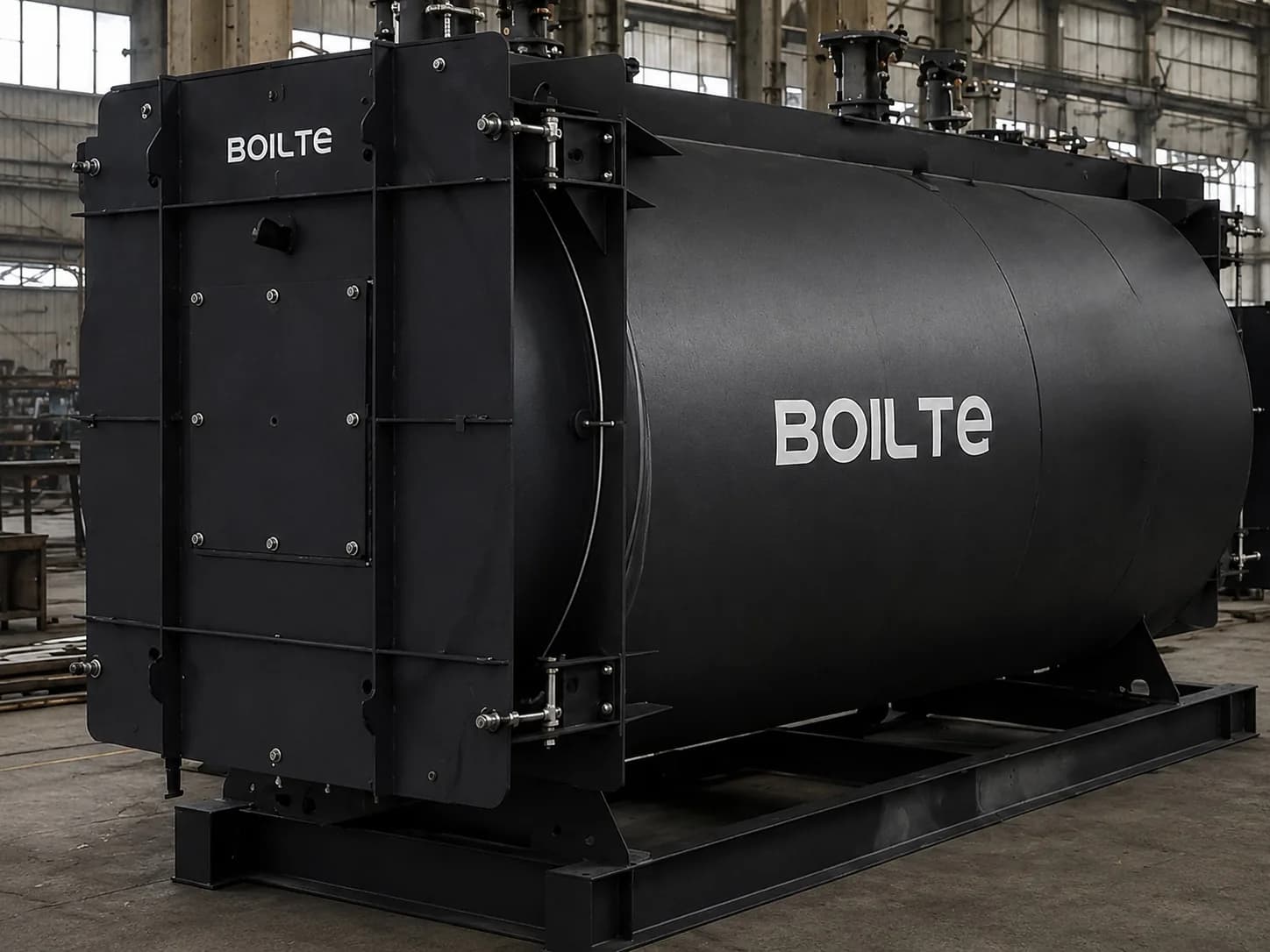
We build up to 1,000 boilers a year and manufacture bespoke units of up to 60 MW, so we see the same set of selection mistakes repeated across very different sectors. The commonest is to choose a boiler on output and price and leave the parameters of the process until later. The correct order is the reverse: first establish what heat the process needs and how precisely, and only then choose the equipment. Below are nine sectors: the duty each of them has, what suits it, and what to look at during selection.
Where selection begins: not with the sector but with the heat-carrier parameters
The sector a company belongs to says less about the duty than is generally assumed. Two plants in the same industry may need fundamentally different equipment, while a chemical works and a timber mill may need the same thermal oil boiler. Four quantities are decisive: the temperature at the point of use, whether heat has to be delivered under pressure, how clean the contact between heat carrier and product must be, and how the load behaves over time. These determine the choice of heat carrier, and the heat carrier determines the type of boiler.
- Hot water
- Space heating, ventilation, hot water supply and low-temperature process duties. The temperature ceiling is limited by the pressure in the circuit.
- Saturated steam
- The principal process heat carrier in industry. It calls for water treatment and a properly organised condensate return.
- Superheated water
- Temperatures above 100 °C without a change of phase, through excess pressure in the circuit. For cases where a steam system would be excessive.
- Thermal oil
- High temperatures at low circuit pressure. The demands on water treatment are lower, those on monitoring the heat carrier higher.
- Recovered heat
- Heat in the flue gases of furnaces and turbines. The most economical source, but it has to be matched to the specific unit.
Once the heat carrier is settled, the choice narrows to one or two types of equipment. Beyond that, sector-specific detail governs not the type of boiler but the requirements for materials, control and design version.
Oil and gas and power generation: large outputs and continuous duty
Oil and gas
The industry solves several duties at once: heating crude oil to reduce its viscosity for pumping, heating water and raising steam to maintain reservoir pressure, LNG regasification, and process steam. Hot-water boilers, superheated water boilers and steam boilers are all suitable, and on remote sites containerised boiler houses supplied ready for operation. The key selection criteria are the climatic version, autonomous running without permanent staff on site, and the actual composition of the fuel — associated gas has an unstable calorific value, and the burner is chosen for that rather than for the nominal figures.
Power generation
The duty rarely comes down to a single boiler: peak-load boiler houses cover demand maxima, heat-recovery boilers behind gas turbines return exhaust heat to the cycle and form the basis of combined-cycle plants, and upgrading existing stations is a separate field. The decisive factor in selection is the operating regime. A peak-load boiler is designed for frequent starts: what matters is how quickly it reaches operating conditions and how well it withstands thermal cycling, not absolute efficiency. An HRSG is tied to one specific turbine — the flow, temperature and composition of the gases dictate the design, which is why such units are almost always bespoke.
Metals and chemicals: high temperatures and precise control
Metals industry
The main resource here is the plant's own waste heat: melting and reheating furnaces release high-temperature gases that can be turned into process steam or heat for the shops. The duty is met by heat-recovery boilers, supplemented by steam and hot-water boilers where the recovered heat is not enough. Look at the dust loading and the aggressiveness of the gas stream: they govern the arrangement of the heating surfaces and the cleaning arrangements. A recovery boiler designed without regard to the real gas composition fouls up within a single season.
Chemicals
The most exacting demands on accuracy: reactor heating with thermal oil, superheated steam, distillation and catalyst drying are processes where a deviation in temperature changes not the output but the quality of the product or the course of the reaction. Thermal oil boilers deliver temperatures appreciably above 100 °C at close to atmospheric pressure in the circuit; the remaining duties are covered by steam boilers and superheated water boilers. The selection criteria are the range and accuracy of control, the resistance of materials to the medium and behaviour at part load: chemical plants rarely run exactly at their design output.
Food processing and pharmaceuticals: steam purity as a technical parameter
Food processing
Pasteurisation, CIP cleaning and sterilisation require clean steam that is acceptable for contact with the product. The duty is met by steam boilers combined with correct water treatment and condensate return. Two things matter in selection: stability of parameters under sharply varying load — plants work in shifts, and the peak when CIP cleaning starts is many times the average consumption; and feedwater quality — economising on water treatment leads to deposits in the boiler and a deterioration in steam quality.
Pharmaceuticals
The most tightly regulated of the sectors listed: Pure Steam for sterile processes, WFI for injectables, autoclave sterilisation. Equipment is judged not only on its thermal performance but on whether it can be validated under GMP. The conclusion for selection is that documentation and material traceability matter as much as the design. Steel grades, certificates, test reports and weld inspection records are planned before the order is placed — at the validation stage a missing document is equivalent to a missing conformity.
Timber, engineering and building materials
Timber processing
An industry where the fuel is often lying on the shop floor. Presses require uniform heating to high temperatures, which is a duty for thermal oil boilers; drying kilns run on steam or hot water; chips and offcuts go into the furnace instead of bought-in fuel. In selection the moisture content and particle size of the waste become decisive: they determine the design of the furnace and the feed system, and seasonal swings in moisture have a direct effect on the output available.
Mechanical engineering
Heat is spread across dissimilar consumers: heating large shop volumes, process steam, plating lines, paint booths. The mix is covered by hot-water and steam boilers, with air heaters used for local duties. The difficulty in selection is not the output but the mismatch between demand profiles: the heating load peaks in winter while the process load is constant all year, so one boiler for everything almost always runs in an unfavourable regime.
Building materials
Steam curing chambers, mould drying and hopper heating are met by steam and hot-water boilers. The particular feature is a sharply variable seasonal load, so look at the lower limit of the control range: a boiler sized for peak demand runs well below its rated output for much of the year, and it is that regime which will determine fuel consumption and service life.
Sectors where heat serves the main process
There are plants for which heat is not part of the technology in the narrow sense, yet a loss of heat supply stops them all the same. Here the requirements shift from accuracy towards reliability.
- Light industry
- Steam for process lines and heating of premises. A standard duty for steam and hot-water boilers, where stable parameters and ease of maintenance matter most.
- Pulp and paper
- One of the most heat-intensive industries: steam is needed continuously and a break in supply stops the line. Redundancy matters more than saving on the investment.
- Animal feed production
- Steam for pelleting and extruding compound feed. Steam parameters affect pellet quality, so stable pressure under a varying load is critical.
- Construction
- Mobile heat on site and concrete curing. Containerised boiler houses and air heaters: rapid start-up and the ability to move between sites are what count.
How to select equipment for your site
The Boilte range covers the duties listed above with a set of equipment types, and in most projects the choice comes down to one or two of them.
- Hot-water boilers
- Space heating, ventilation, hot water supply, low-temperature process duties.
- Steam boilers
- Process steam, from food processing through to the metals industry.
- Superheated water boilers
- Temperatures above the hot-water range without a steam system.
- Thermal oil boilers
- High-temperature heating at low pressure: presses, reactors, drying.
- Heat-recovery boilers
- Returning the heat of furnace and turbine flue gases to the cycle.
- Outdoor boiler houses
- Containerised solutions for sites with no suitable building.
Air heaters for direct air heating and components for existing boiler houses are supplied separately, and bespoke units are built up to 60 MW, including to the customer's own documentation.
To make the conversation specific, prepare your input data: the heat output and heat-carrier parameters at the point of use, the load profile through the day and the year, the fuel available, the siting conditions and the requirements for the control system. If your process has a source of waste heat, mention it separately — it often changes the economics of a project more than the choice between two boiler models.